GCSE Physics · Required practical
Hooke's Law Virtual Practical
Hang masses from a spring, read the pointer at eye level, and use a force–extension graph to find the spring constant.
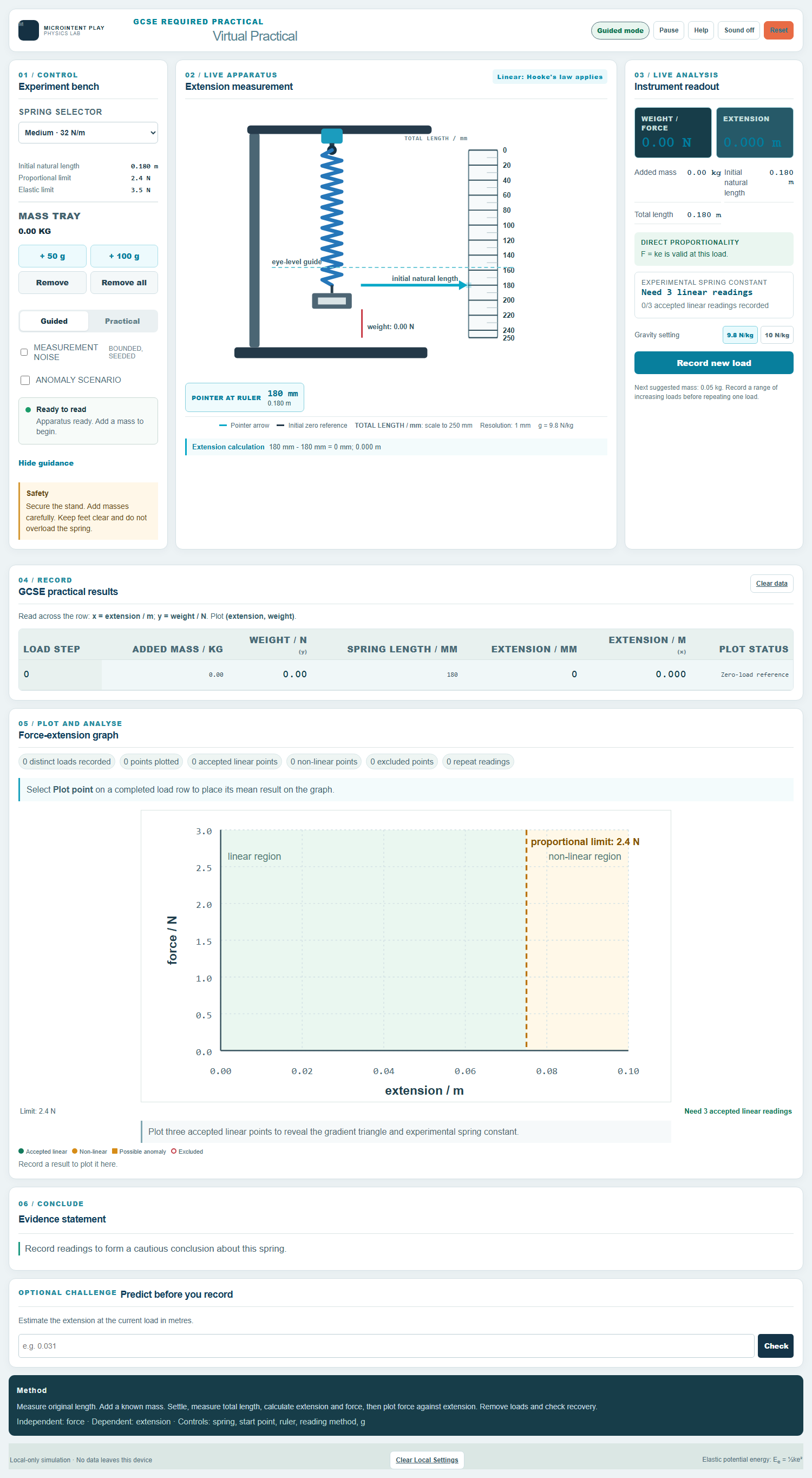
What you will investigate
This practical investigates how the extension of a spring changes as the applied force increases. You add known masses, allow the spring to settle, and record the position of a pointer against a ruler.
The independent variable is the applied force. The dependent variable is the extension. The spring, the ruler position, the reading method and the value of g are controlled so that the evidence can be compared fairly.
The resulting force–extension graph shows whether the spring obeys Hooke's law in the range tested, and its gradient gives an experimental value for the spring constant.
Learning objectives
- Calculate weight from mass using W = m g.
- Measure original length, total length and extension accurately.
- Plot force against extension and describe the relationship.
- Use the gradient of the straight-line region to determine the spring constant.
- Recognise the limit of proportionality and the elastic limit.
- Evaluate repeats, anomalies and the effect of measurement resolution.
Before you start
Apparatus
- Retort stand, boss and clamp
- Spring with a pointer or scale marker
- Metre ruler clamped vertically
- Mass hanger and 50 g or 100 g masses
- Safety goggles and a clear working area
Safety
- Clamp the stand securely and keep feet clear of falling masses.
- Do not exceed the spring's safe load or stretch it permanently.
- Read the pointer at eye level to avoid parallax error.
- Remove masses carefully and check that the spring returns to its original length.
Method
Set up the apparatus
Clamp the spring and ruler so that the pointer is clearly visible. Check that the ruler is vertical and that the zero mark is in a sensible position.
Record the original length
With no load on the spring, record the pointer position. This is the reference length used to calculate extension.
Add a known mass
Add a mass to the hanger, wait for the spring to stop moving, and read the pointer at eye level. Record the total length.
Calculate extension and force
Subtract the original length from the total length. Calculate the weight of the mass using W = m g and record both values.
Repeat with increasing loads
Increase the load in equal steps and repeat the measurement. Take repeats where possible and watch for readings that do not fit the pattern.
Plot and analyse
Plot force on the y-axis against extension on the x-axis. Draw a best-fit line through the linear region and calculate its gradient.
Check elastic behaviour
Remove the masses and confirm that the spring returns to its original length. A permanent extension indicates that the elastic limit was exceeded.
The physics
In the linear region, the force–extension graph is a straight line through the origin. Doubling the force doubles the extension.
The gradient of the force–extension graph is the spring constant k. A stiffer spring has a steeper graph and a larger k.
The limit of proportionality is the point beyond which force is no longer proportional to extension. The elastic limit is the point beyond which the spring does not return to its original length. These limits are related but not necessarily the same.
A graph that curves beyond the linear region is still useful evidence: it shows where the simple proportionality model stops working.
W = m gWeight in newtons from mass in kilograms and gravitational field strength in N/kg.extension = total length − original lengthUse the same unit for both lengths, usually centimetres or metres.F = k eHooke's law: force is proportional to extension in the linear region.k = F / eThe spring constant in N/m is the gradient of a force–extension graph.Ee = ½ k e²Elastic potential energy stored by the spring, where e is the extension.Using the virtual practical
Guided mode
Guided mode calculates the extension and force from your chosen mass and displays the expected readings. Use it to check your understanding before moving to independent measurement.
Practical mode
Practical mode asks you to read the pointer yourself and enter the value. It preserves the measurement decisions that matter in a real practical.
What the dashboard records
- Spring selection and original length
- Mass, weight and pointer reading
- Calculated extension and force
- Repeats and excluded anomalies
- Force–extension graph and best-fit gradient
Results and analysis
Relationship
Force and extension should be directly proportional in the linear region, so the graph should be a straight line through the origin.
Graph
Plot force on the y-axis and extension on the x-axis. The gradient is the spring constant. The intercept should be close to zero for a correctly zeroed scale.
Conclusion
State the experimental spring constant with its unit, identify the range over which Hooke's law is supported, and explain any curvature or permanent extension.
Common misconceptions
- The spring constant is the force on the spring.
- The spring constant is the force per unit extension. It is the gradient of the force–extension graph, measured in N/m.
- Extension is the same as total length.
- Extension is the change from the original length: extension = total length − original length.
- Any straight-line graph proves Hooke's law.
- Hooke's law requires a straight line through the origin in the proportional region. A line with an intercept needs interpretation.
- The limit of proportionality and the elastic limit are always identical.
- They are separate features. The spring may stop being proportional before it stops returning to its original length.
Teacher notes
The dashboard keeps the spring model deterministic so that repeated readings are consistent, while optional noise and anomaly scenarios provide measurement-skills practice.
Interactive dashboard
Run the practical
Guided mode calculates the extension and force from your chosen mass and displays the expected readings. Use it to check your understanding before moving to independent measurement.
- Runs locally in the browser
- Keyboard, mouse and touch support
- Reduced-motion preference respected
- No account or personal data required