GCSE Physics · Required practical
Acceleration Virtual Practical
Vary accelerating force or moving mass, measure velocities with light gates, and test Newton's second law: F = ma.
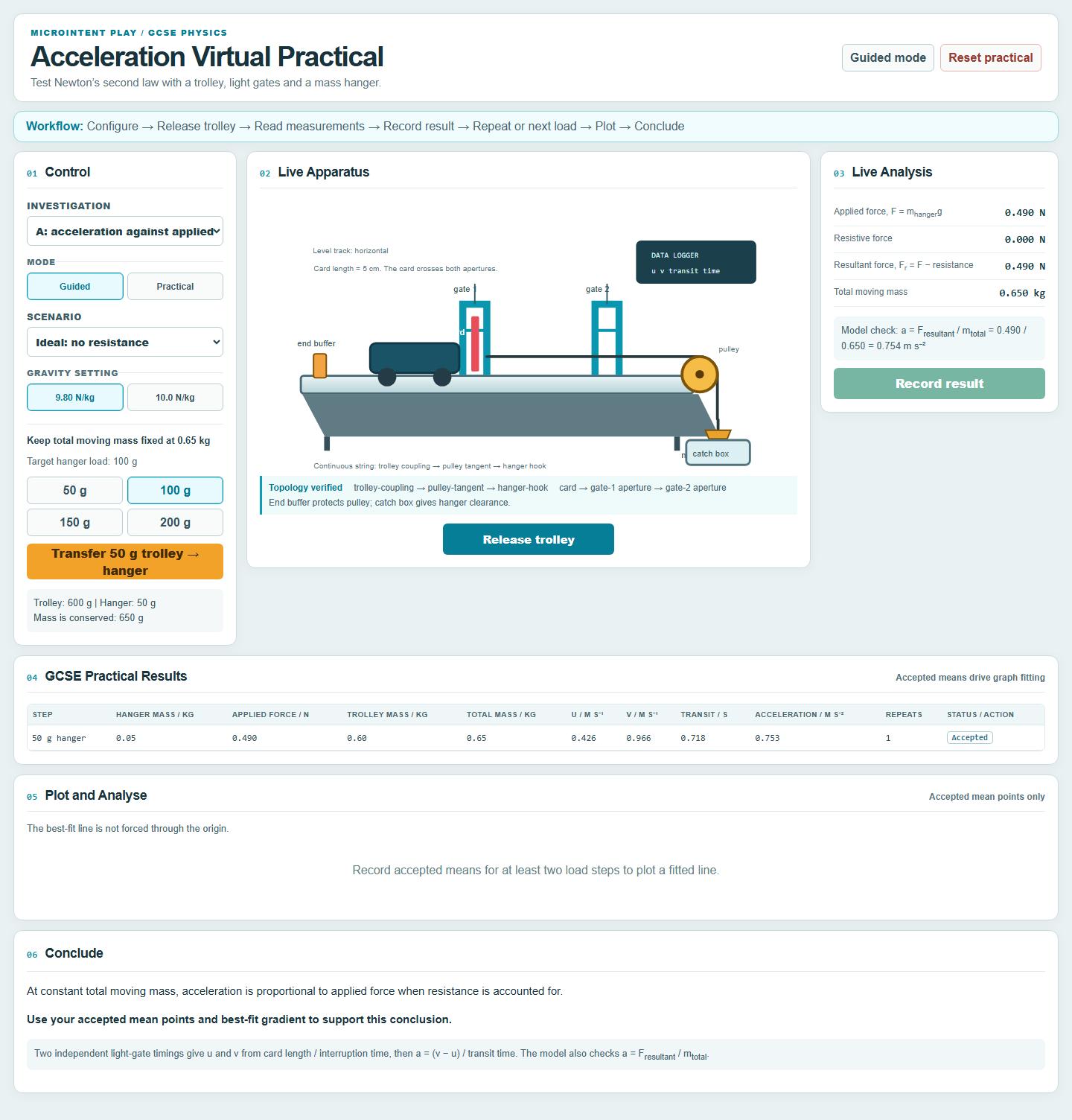
What you will investigate
This practical investigates the relationship between resultant force, mass and acceleration (Newton's second law: F = ma).
In Investigation A, accelerating force is varied while keeping total moving mass constant by transferring masses between the trolley and the hanger.
In Investigation B, trolley mass is varied while keeping the hanging force constant.
Two light gates calculate initial and final velocities from a 5 cm interrupt card, determining acceleration from a = (v - u) / t.
Learning objectives
- Investigate how resultant force affects acceleration at constant mass.
- Investigate how mass affects acceleration at constant resultant force.
- Calculate speeds from card length divided by light-gate interruption time.
- Determine acceleration from a = (v - u) / transit time.
- Interpret best-fit lines: gradient = 1 / total mass in Investigation A; resultant force in Investigation B against reciprocal mass.
- Identify the effect of resistive forces (friction and slope) on the acceleration threshold.
Before you start
Apparatus
- Linear track with end buffer and pulley
- Dynamic trolley with 5 cm interrupt card
- Two light gates connected to a digital timer / data logger
- Mass hanger and slotted 50 g masses
- Catch box to receive the falling mass hanger safely
- Connecting string of constant tension
Safety
- Use a catch box with soft padding below the mass hanger to avoid foot injuries.
- Ensure an end buffer stops the trolley before it collides with the pulley.
- Do not overload the hanger beyond the track's safe operating limit.
- Keep the runway clear of obstructions during release.
Method
Level the runway
Set up the track and check that the trolley does not accelerate under zero resultant force.
Investigation A: Vary force at constant total mass
Start with all transfer masses on the trolley. Move one 50 g mass to the hanger, release the trolley, record u, v and transit time, and calculate acceleration. Repeat for each transfer.
Investigation B: Vary mass at constant force
Keep the hanger mass fixed at 50 g. Add 50 g masses directly to the trolley to increase total moving mass and measure acceleration.
Plot graphs and conclude
Plot acceleration against applied force for Investigation A and against reciprocal total mass (1 / m) for Investigation B.
The physics
At constant mass, acceleration is directly proportional to resultant force (straight line through the origin in the absence of friction).
At constant force, acceleration is inversely proportional to total moving mass (straight line when plotted against 1 / m).
When friction is present, a minimum applied force is required to produce motion, causing a positive x-intercept on the force axis.
F = m aResultant force (N) = mass (kg) × acceleration (m/s²)u = d / t₁ and v = d / t₂Speed = card length / gate interruption timea = (v - u) / ΔtAcceleration = change in velocity / transit time between gatesF_resultant = F_applied - F_resistanceResultant accelerating force accounting for frictionUsing the virtual practical
Guided mode
Guided mode prompts the learner to transfer masses step-by-step to enforce conservation of system mass.
Practical mode
Practical mode allows free exploration of forces, masses, friction and slope angles.
What the dashboard records
- Hanger mass (kg) and applied force (N)
- Trolley mass (kg) and total moving mass (kg)
- Gate 1 speed u, Gate 2 speed v, transit time (s)
- Calculated acceleration (m s⁻²)
- Repeats, accepted means and regression fit parameters
Results and analysis
Relationship
Acceleration is directly proportional to resultant force and inversely proportional to total mass.
Graph
In Investigation A, acceleration against applied force gives a straight line whose slope is 1 / total mass. In Investigation B, plotting against 1 / total mass yields a line whose slope is resultant force.
Conclusion
The experimental evidence confirms F = ma for linear acceleration.
Common misconceptions
- Moving masses from the trolley to the hanger changes the total moving mass.
- The whole system (trolley plus hanger) accelerates together. Moving mass between them conserves total system mass while changing the accelerating force.
- A constant force produces a constant velocity.
- A constant resultant force produces a constant acceleration. Velocity continuously increases while the resultant force acts.
- Only the trolley's mass accelerates.
- The falling hanger and accelerating trolley form a single coupled system; both masses accelerate at the same rate.
Teacher notes
Emphasise to students that transferring masses from trolley to hanger is what keeps total system mass constant during force investigations.
Interactive dashboard
Run the practical
Guided mode prompts the learner to transfer masses step-by-step to enforce conservation of system mass.
- Runs locally in the browser
- Keyboard, mouse and touch support
- Reduced-motion preference respected
- No account or personal data required